What to Buy on GovDeals: The Best Categories for Real Savings


When government agencies need to get rid of stuff, they put it up for auction.
That’s what makes government auction sites, like GovDeals.com, a great place to find truly unique finds at a steep discount.
GovDeals lets you search thousands of listings in just about every category, from heavy equipment and real estate to fine art and jewelry.
This guide breaks down how GovDeals works, why prices are often so low, the best categories to shop for savings, and where you should slow down or skip entirely.
What Is GovDeals and Why Prices Are So Low
Think of GovDeals like eBay but for governments. It’s an online auction platform where government agencies sell surplus, seized or outdated items directly to the public.
Back in the day, many agencies placed ads in the local newspaper when they wanted to sell off old equipment or seized property.
But now, cities, counties, school districts, police departments, utilities and other public agencies use GovDeals and other auction sites, where they can reach a bigger audience, to clear out items they no longer need. Because the goal is disposal and cost recovery, not retail profit, many listings start with low opening bids.
Prices are often low for a few practical reasons:
- Items are sold as-is, with limited buyer protections
- Buyers may have to handle local pickup and transport
- Listings can be inconsistent because agencies post their own photos and notes
- Some items are bulky, specialized or expensive to move, which reduces competition
Save More Money Beyond Snagging Cheap Stuff on GovDeals
If you’re here reading about finding great deals on GovDeals, we imagine you’re into saving money. Well, you’re in luck. We’ve got even more ways to save. From saving on insurance to interest, these are some of our favorite ways.
| Offer | Why We Like It | What You Need to Do | Start Saving |
|---|---|---|---|
| The Penny Hoarder Auto Insurance Tool | Save ~$500 per year | Provide some basic information | |
| AmOne | Save on interest payments with a personal loan | Answer a 10 quick qualifying questions | |
| Balance Transfer Credit Cards* | Cancel Your Interest Payments Until 2026 | Apply for a 0% Interest Credit Card | |
| Upside | Save $40/month on Gas | Download this free app |
Best Categories to Save Money on GovDeals
You can find just about anything on GovDeals, including exercise equipment, school projectors, laptops, food storage items, jewelry, kitchen equipment, trucks, trading cards, RVs and hunting knives.
However, the best categories to save money on GovDeals include vehicles, heavy equipment, office furniture, electronics and bulk maintenance supplies.
The categories below tend to offer the most consistent savings because agencies replace these items regularly and the resale market is often smaller than you’d expect.

Vehicles and Transportation Equipment
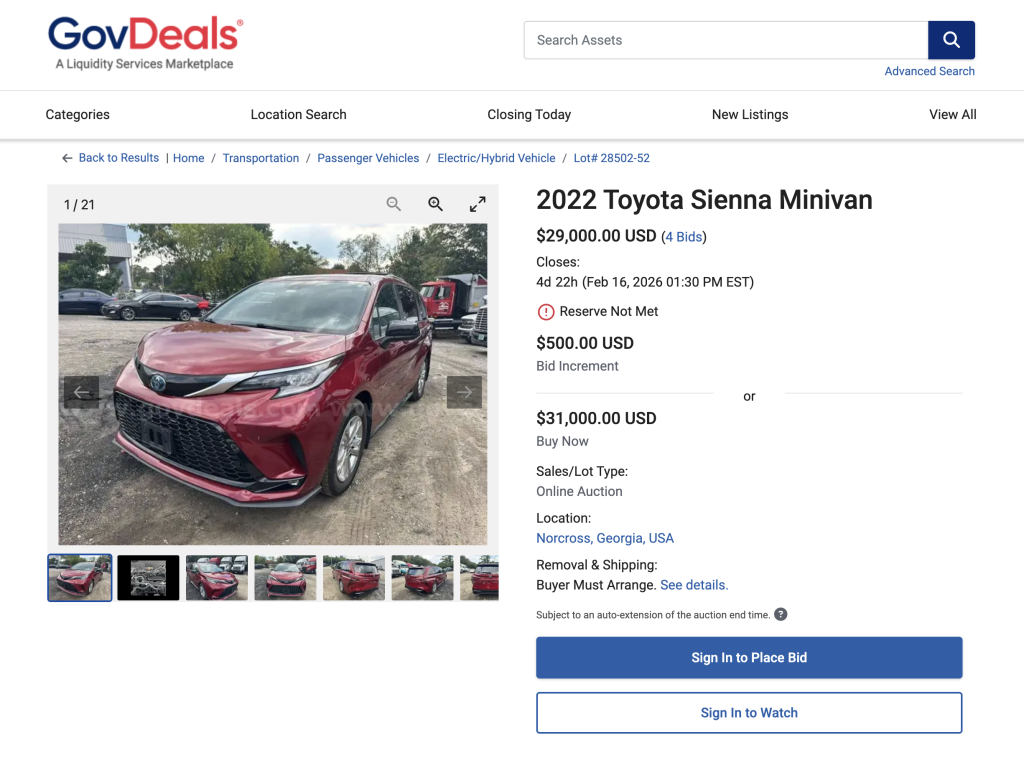
You can often find GovDeals listings for vehicles and transportation equipment at steep discounts because many agencies retire their vehicles due to age or high mileage, and some rotate fleets on a fixed schedule.
Common listings include sedans, pickups, vans, buses, trailers and specialty vehicles like firetrucks. Some get retired due to age or high mileage, while others are replaced as part of routine fleet updates.
If you’re considering buying a vehicle off of GovDeals, you should keep a few things in mind.
- Consider mileage and maintenance history when it’s available
- Factor in towing or transport if the vehicle isn’t drivable
- Plan for registration, taxes, and any buyer fees
Heavy Equipment and Industrial Tools
Utilities and public works departments may list generators, compressors, forklifts, skid steers and other industrial-grade tools when they refresh equipment or clear storage. These items often sell for cheap on GovDeals because fewer bidders can inspect, move or repair them. But even when an item needs work, the discount can be significant enough to make sense for experienced buyers.
This category tends to work best for buyers who:
- Can assess condition from listings and photo
- Have access to transport or hauling
- Know what repairs and parts typically cost
Office Furniture and Fixtures
Office furniture is one of the most dependable GovDeals categories for everyday savings.
Desks, office chairs, file cabinets, shelving and conference tables show up frequently when agencies renovate, downsize or replace worn pieces. These items often stay inexpensive because pickup is local and the items can be bulky.
This category is usually a good fit if you’re furnishing:
- A home office on a budget
- A small business workspace
- A school, nonprofit or community space

Electronics and IT Equipment
Agencies often sell monitors, desktops, laptops, printers and networking gear after upgrades. While these items’ performance may be dated, some items are business-grade and can still handle basic tasks. So, electronics and IT equipment can be a solid value when you expect older models and limited guarantees.
This category is easiest to shop when you:
- Treat listings as unknown condition, unless stated otherwise
- Assume accessories like cables or chargers may be missing
- Plan to wipe, reset, or refurbish devices before use
Maintenance, Safety and Utility Supplies
Maintenance, safety and utility supplies, like tools, signage, lighting, storage bins, shop supplies, safety gear and facility maintenance items, are often in better shape because they’re surplus inventory rather than worn-out equipment.
And because agencies often purchase in bulk, leftover stock can be sold off at steep discounts.
This category is often best for:
- Homeowners working through ongoing projects
- Landlords and property managers
- Small facilities that need practical supplies
Categories That Offer the Biggest Discounts (and Why)
To recap, you’ll find the biggest discounts on GovDeals for items that are hard to ship, hard to move or difficult for casual buyers to evaluate. Why? Government agencies replace items based on schedules, policies and budgets — not only when something breaks. That predictable turnover creates a steady inventory, while logistics and inspection barriers keep bidding competition lower than it would be in retail marketplaces.
So, if your goal is savings, shopping by category is usually more reliable than chasing one-off “wow” deals.
Categories to Be Careful With on GovDeals
Some GovDeals categories can look like a bargain but become expensive once you account for risk, missing parts, or pickup challenges.
Categories that often require extra caution include:
- Consumer electronics with vague testing notes
- Items missing key parts or proprietary components
- Specialized equipment without documentation
- Anything that’s hard to inspect or expensive to transport
If you can’t confirm items’ condition or easily absorb repair costs, bidding conservatively or skipping entirely is often the smartest move.
How to Buy on GovDeals Without Overpaying
You can avoid overpaying on GovDeals by setting a firm price limit and factoring total costs into every bid. Because auctions can trigger last-minute bidding pressure, it helps to decide your maximum before the final minutes.
A practical checklist before bidding:
- Read the full listing terms and pickup requirements
- Look for condition notes like “untested,” “powers on” or “no keys”
- Estimate total cost, including transport and buyer fees
- Check comparable used prices for context
- Bid based on risk, not just best-case scenarios
The best GovDeals savings usually go to buyers who stay patient, bid deliberately and treat unknowns as real costs.

GovDeals FAQs
GovDeals is worth it if you’re comfortable buying items as-is and handling pickup logistics yourself. The savings can be real, but the trade-off is more responsibility compared to buying from a store.
GovDeals listings commonly include surplus vehicles, equipment, furniture, electronics, tools and maintenance supplies from public agencies. Availability depends on what local agencies are currently retiring or clearing out.
Yes. Regular people can buy from GovDeals by creating an account and following the auction rules. You don’t need to be a business, but you do need to meet payment requirements and handle pickup.
GovDeals prices are often low because agencies want to move surplus quickly, items are sold as-is and many purchases require local pickup. Fewer bidders and higher logistics effort can keep final prices down.
The biggest risks include unclear condition, missing parts, no returns and unexpected pickup or repair costs. You can reduce risk by reading listings carefully and bidding based on total cost, not just the current price.
You can estimate value by checking comparable used listings and subtracting realistic costs like transport, repairs and missing accessories. When an item’s condition isn’t clear, bidding lower is usually the safer choice.
Final Verdict: Is GovDeals a Smart Way to Save Money?
GovDeals can be a smart way to save money when you shop by category, set a firm bidding limit and treat auctions as as-is purchases — not retail deals. Vehicles, office furniture, heavy equipment and bulk maintenance supplies tend to offer the most repeatable value, while categories with uncertain condition or missing components carry higher risk.
Savings are never guaranteed, but focusing on categories instead of individual listings helps reduce risk, avoid overbidding and make GovDeals savings more consistent over time.