Robinhood Review 2023: Pros and Cons

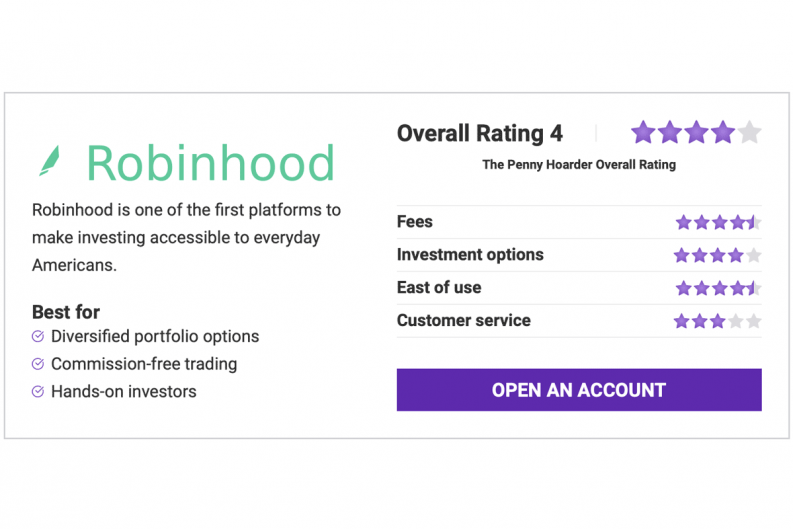
- Diversified portfolio options
- Commission-free trading
- Hands-on investors



Did the movie “The Big Short” go right over your head? Does Nasdaq sound more like a foreign country than a stock market index? When you hear about bear markets and bull markets, do you envision adorable cartoon mammals browsing for fresh produce at a local farmers market?
You’re not alone.
The stock market can be confusing, and if you’re not a financial wizard in the Wall Street inner circle, you might be tempted not to bother with stock and options trading at all. But you’d be missing out.
That’s where apps like Robinhood come in. In this Robinhood review, we’ll discuss how Penny Hoarders can go from novice traders to expert stock market gurus, no matter how much or how little they have to invest.
What Is Robinhood?
Robinhood offers a unique brokerage account with commission-free investing from your smartphone. Robinhood has been around for the better part of a decade — the company launched April 18, 2013. Its two founders, Vladimir Tenev and Baiju Bhatt, met at Stanford University as roommates and eventually moved to New York City to build finance companies.
Upon seeing firsthand how Wall Street insiders and powerhouse firms paid almost nothing when trading stocks while average Americans had to pay a commission fee for every trade, they instead headed to California to develop a financial product that allowed everyone to trade easily and affordably.
The resulting financial product, of course, was Robinhood. The company today is headquartered in Menlo Park, California.
Robinhood has not been without its challenges. It’s famous for serious outages during market surges in 2020 and its role in the early 2021 market chaos related to the Reddit forum called r/wallstreetbets, where it restricted member access to securities like GameStop, Nokia and AMC. More recently, Robinhood laid off 23% of its staff, just one example of the massive tech industry layoffs in 2022, and also has been in the news for questionable trades.
However, Robinhood’s overall mission to make stock market trading accessible for everyone is admirable, and it is one of many investment and trading tools that seeks to put power back in consumers’ hands to elevate the financial status of the average American.
That’s a product that, even with its flaws, we can get behind.
Our Favorite Investing Tools
Are you looking to start your investment journey? Or maybe you’re wondering if there are better platforms for you than what you’re currently using. If you’re trying to get the most out of your investments, these are our top tools.
| Offer | Why We Like It | What You Need to Do | Take Action |
|---|---|---|---|
| SoFi Active Investing | No commissions and no contract fees (other fees apply)* | Only $5 to invest | |
| Wealthfront | Automated accounts** | $500 minimum to invest | |
| Stash | Investment strategy tailored to your goals*** | $5 minimum to invest |
What Tradable Securities Does Robinhood Offer?
The Robinhood platform is a great solution for free(!) trading of stocks, options, ETFs (exchange-traded funds) and ADRs (American Depositary Receipts), as well as cryptocurrency trading. The trading platform requires no minimum balance, offers fractional shares and includes plenty of educational resources. While Robinhood is most known for trading stocks and crypto, you can also use it for cash management.
Robinhood does not, however, offer access to mutual funds and bonds.
In 2021, Robinhood began to offer IPO access, meaning investors could purchase shares of stock in new companies at the IPO price before they go public. And in 2022, it introduced individual retirement accounts, or IRAs.
What Can You Trade on Robinhood?
- U.S. exchange-listed stocks
- U.S. exchange-listed ETFs
- Options contracts for U.S. exchange-listed stocks and ETFs
- ADRs for more than 650 globally listed companies
- Cryptocurrency
What Can’t You Trade on Robinhood?
- Foreign-domiciled stocks
- Select OTC equities
- Preferred stocks
- Tracking stocks
- Stocks that trade on foreign exchanges
- Royalty trusts
- Units
- Closed-end funds
- Mutual funds
- Bonds
- Fixed-income trading
- New York registry shares
- Limited partnerships
- Chinese securities affected by the Nov. 2020 executive order
- Spanish ADRs
How to Get Started with Robinhood
To sign up with a Robinhood brokerage account, simply visit the website and press the black “sign up” button.
Hot Tip: Robinhood is currently offering one free fractional share upon signup. There are 20 fractional shares available to choose from. To generate its 20 offers, Robinhood chose the two largest S&P 500 companies within each of the top 10 sectors based on market cap.
To open an account with Robinhood, you have to meet a few individual requirements:
- You must be 18 or older.
- You need a valid Social Security Number (Note: You may not use a Taxpayer Identification Number).
- You must be a legal U.S. citizen, U.S. permanent resident or have a valid U.S. visa and have an address in the 50 states or Puerto Rico (exceptions made for members of the U.S. military stationed outside the country).
The Robinhood trading platform is accessible via the web or app (iOS and Android).
The process of activating your account can take some time. You’ll start by submitting an application. While Robinhood reviews the application, you can queue one deposit to fund your account, but you won’t be able to use that money to make trades until account approval.
Typically, Robinhood will take a few days to either approve your application or request more information. If they request more information or documentation, be prepared to allow five to seven days for review.
How Much Does Robinhood Cost?
Trading with Robinhood is free. That’s the whole reason its founders launched the company: free stock trading for regular people. That means you won’t pay commissions on equity trades or options trades. However, you could wind up having to pay account transfer fees, wire fees, check fees and live broker fees, among others.
In addition, Robinhood Gold allows you to trade on margin at a 8% annual rate (12% for non-Gold members). It also allows you to make bigger deposits with faster fund access. This fee for the margin account is $5 per month.
Robinhood Gold, Explained
Margin trading means trading with borrowed money. If you invest in a bad stock and lose money on the investment, you’ll owe that money back.
For example, say you borrow $500 to invest in a stock worth $500. But that stock plummets to $100. You will still owe the remaining $400 back to Robinhood. That’s what makes margin trading a little too risky for novice traders.
Not only that, but if you borrow more than $1,000 to trade on margin, you’ll owe 8% yearly interest on that borrowed money above that $1,000.
Because Robinhood is targeted at new investors — and margin trading is a risky practice that can break even the savviest stock market gurus — we recommend that you invest with your own money, and make sure it’s money that, if lost, will not financially ruin you.
In fact, one of our biggest stock trading tips for beginners is to stay away from margin trading.
So How Else Does Robinhood Make Money?
If Robinhood is commission-free and not everyone uses Robinhood Gold, how does Robinhood make money off you? Robinhood spells this out transparently on its website:
- Rebates from market makers and trading venues: Robinhood has developed relationships with market makers and trading venues that pay Robinhood rebates for directing orders to those makers and venues. In the industry, this is known as payment for order flow (PFOF).
- Stock loans: Robinhood can loan stocks held in your account to traders and hedge funds for short selling. Robinhood gets to keep the money it makes from this; you as the investor do not share in the wealth.
- Income from cash: If you have idle cash sitting uninvested but haven’t moved it into a cash management account, Robinhood earns interest on that cash.
- Cash management account: Every time you use the debit card for your cash management account, Sutton Bank (the card issuer) earns a fee, which it shares with Robinhood.
- Robinhood Gold: Robinhood makes money off every Gold subscription, both from the monthly fee and from margin interest.
Robinhood Review: Key Features
In this section, we will break down some of the hallmark features of Robinhood.
Robinhood: At a Glance
| Feature | Details | More Details | ||
|---|---|---|---|---|
Trading fees |
$0 |
n/a |
||
Account minimum |
$0 |
n/a |
||
Tradable securities |
Stock options |
ETFs ADRs; crypto |
||
Mobile app rating |
4.2 on App Store |
4 on Google Play |
||
Customer support |
Talk to a live agent 24 hours a day, 7 days a week |
30-minute guarantee |
||
Other key features |
Fractional shares |
IPO access |
||
Beginner perks |
Educational resources |
Free stock at sign-up |
Commission-Free
Robinhood’s schtick has long been that it offers commission-free trading. That means you will spend $0 for stock trading and $0 for options trading. ETFs also are commission-free.
This was the original mission of the founders, but in the time since launching their revolutionary idea, some of the bigger, traditional players, like Fidelity and Charles Schwab, have latched onto the same idea — and are backed by a better customer support system and a better-supported platform.
That has meant the Robinhood trading platform has had to find new ways to differentiate, like cryptocurrency and fractional shares. More on these below.
No Account Minimum
Of course, you will need to put money in your account to invest, but Robinhood does not have an account minimum, nor does it charge you for having a low or zero balance. And with fractional shares being an option, you can get started investing with as little as a dollar in your account.
Note: To purchase a security on margin (through Robinhood Gold), you need to have at least $2,000 in your account. This is not a Robinhood requirement but rather a regulation set by the Financial Industry Regulatory Authority (FINRA).
Cryptocurrency Trading
Cryptocurrency is still a foreign concept to many investors, but just because something is new and scary (also, it’s been around since 2009, so it’s hardly new anymore) doesn’t mean you shouldn’t invest. Not all brokers allow you to buy and sell cryptocurrency, but Robinhood offers support for multiple cryptocurrencies, including Bitcoin, Dogecoin and Ethereum, with Robinhood Crypto (open 24/7).
In keeping with the whole “Robinhood is free” theme, Robinhood charges 0% for crypto exchanges. Some competitors charge up to 4%.
Fees
Not only does Robinhood offer free trades on stocks, options, ETFs and ADRs, it also has no account fees, inactivity fees or ACH transfer fees. Robinhood Gold, as mentioned, currently costs $5 a month.
Mobile App
Robinhood was created in the heart of Silicon Valley in Menlo Park, so, unsurprisingly, its mobile app is streamlined and easy to use. At the time of writing, the Robinhood app had 4.2 stars in the App Store based on more than 4 million reviews.
Its website, too, is streamlined. It doesn’t have a lot of extras, which is great if you are a novice trader. A more senior investor may find the site lacking, however.
Customer Support
While Robinhood offers customer support, this seems to be the biggest issue raised by members. Customer review sites often are littered with complaints that customer service is virtually nonexistent, especially pre- and post-market.
In an effort to improve its relatively low-rated customer support options, Robinhood rolled out a new customer service feature in 2021. This allows customers to request a call back, 24/7. Robinhood promises an agent should call within 30 minutes.
No Mutual Funds and Bonds
While commission-free stocks, options, ETFs and even crypto are a big pro of Robinhood, its lack of mutual funds and bonds can be frustrating for traders who want to diversify. As far as retirement accounts go, mutual funds are a key part of a retirement investment strategy.
Fractional Shares
True to its goal of making growing financial wealth more accessible to average Americans, Robinhood released fractional share options in late 2019. This means, if you can’t afford an expensive stock valued at, say, $1,000, you could instead buy a fraction of the stock, maybe $100 worth of it, or even just $10.
Right now, Robinhood allows you to buy as small as one-millionth of a share. Just like full shares, trading of fractional shares can be done in real time and is commission-free.
Recurring Investments
Another tool that Robinhood has introduced in recent years is recurring investments, which is a nice pairing with a fractional share investment strategy. For example, if Company X’s stock hovers around $200, you can set up a recurring investment in a fractional share at $25/week. Within roughly eight weeks, you could own a full share.
Most brokers structure recurring investments as buying by the share, which typically leaves your account funded with some uninvested cash. But Robinhood’s recurring investments are structured as buying by a dollar amount, which makes the best use of all your invested cash.
IPO Access
New in 2021, Robinhood gave customers access to purchase stocks in upcoming IPOs (initial public offerings) at the IPO price. No minimum account balances or special status requirements are necessary.
Cash Management Account
Another cool feature of Robinhood is the associated cash management account. You can have your paycheck deposited here, use it to pay bills and deposit checks, and, of course, fund your account. Like a proper bank account, this account gives you access to more than 75,000 fee-free ATMs (pretty much everywhere Mastercard is accepted) and comes with a debit card. And the best part: It earns 1.5% APY (5% APY for Gold members). For reference, the FDIC says the average interest rate for a savings account is 0.33% APY. And because the account is operated through a network of banks, you’ll get more than the typical $250,000 FDIC insurance; instead, the account is insured up to $1.25 million.
Educational Resources
A lot of now-outdated Robinhood reviews mention the lack of educational resources. We couldn’t find anything to be less true of Robinhood. Perhaps in response to some of those reviews, Robinhood has stepped up its game, with plenty of online resources on the website as well as a daily financial newsletter called Robinhood Snacks. Robinhood markets it as a “3-minute newsletter with fresh takes on the financial news.”
Robinhood makes it easy to access news from Reuters, Cheddar, WSJ Markets, etc. Upgrading to Robinhood Gold gets you access to Morningstar, Nasdaq and Nasdaq Totalview Level 2 Market Data.
What Customers Are Saying About Robinhood
Because of Robinhood’s role in the recent GameStop market chaos and following layoffs in 2022, many angry investors and emboldened Redditors spoke their minds online, meaning Robinhood’s current ranking on sites like the Better Business Bureau (BBB) and Google Play is suffering. This is more a reflection of reviewers’ overall criticisms of capitalism, hedge fund managers and the 1% than it is on Robinhood, which, if you take a step back, is really trying to help the average investor.
Pros and Cons of Robinhood
There’s a lot to love about Robinhood, especially if you are a new trader. More experienced traders may prefer a different approach to trading, however. Weigh these pros and cons before deciding on a Robinhood brokerage account.
Pros
- The educational content is great if you are new to the stock market and want to learn the language.
- The cash management account makes it easy to fund your investments and earns a decent APY.
- You can strategize by combining fractional shares and recurring investments to diversify your assets and minimize uninvested cash, no matter how much you have to invest.
- The commission-free trading and no account minimum truly make this accessible to anyone who wants to invest.
- Robinhood gives you the option of investing in cryptocurrency and access to IPOs.
- The mobile app and online trading platform are known for their ease of use.
- There are no account or trading fees, nor are there account inactivity or ACH transfer fees
- Robinhood is running a promotion wherein you get free fractional share upon signing up.
Cons
- The role Robinhood played in limiting investments in squeeze stocks (like GameStop) in early 2021 brought the original mission of the company into question. The 2022 layoffs didn’t help.
- Customer support is lacking, especially compared to larger brokers. Robinhood customers complain that customer service is especially challenging pre- and post-market.
- Robinhood lacks mutual funds and bonds.
- By not charging investors commission, Robinhood instead makes money through the payment for order flow, a common standard among online brokers. Some critics say this is a conflict of interest.
Are There Alternatives to Robinhood?
If you want to stay away from major players like TD Ameritrade and Charles Schwab, Robinhood is arguably the most popular trading tool.
Its most notable competitor is Webull. Both Robinhood and Webull have their advantages; it truly comes down to your personal preferences. But Robinhood and Webull aren’t your only options. In fact, we’ve rounded up the best investment apps currently offered; choosing the right app depends on your own specific needs and investment strategy.
Frequently Asked Questions (FAQs) About Robinhood
Still have questions about opening a Robinhood account? We’ve provided answers to some of the questions our readers are most commonly asking.
Yes, Robinhood is a safe platform for investing. Robinhood is a member of the SIPC (Securities Investor Protection Corporation), meaning your funds are insured up to $500,000. Robinhood also is regulated by the Securities and Exchange Commission (SEC).
Yes, Robinhood offers a brokerage account as its key offering, but you can also open a cash management account with Robinhood.
Robinhood processes your dividends automatically, crediting cash to your account by default.
Most investors will be fine with Robinhood’s free investing accounts. Being a Robinhood Gold member is ideal for margin trading, but we don’t recommend this unless you are a more seasoned investor.
Timothy Moore covers banking and investing for The Penny Hoarder from his home base in Cincinnati. He has worked in editing and graphic design for a marketing agency, a global research firm and a major print publication. He covers a variety of other topics, including insurance, taxes, retirement and budgeting and has worked in the field since 2012. Freelancer Lauren Richardson contributed to this post.
SoFi Active Investing
*Investment Products: Are not FDIC-insured, are not bank guaranteed and may lose value.
1. Other fees, such as exchange fees, may apply. Please view our fee disclosure to view a full listing of fees.
2. Investing in alternative investments and/or strategies may not be suitable for all investors and involves unique risks, including the risk of loss. An investor should consider their individual circumstances and any investment information, such as a prospectus, prior to investing. Interval Funds are illiquid instruments, the ability to trade on your timeline may be restricted. Brokerage and Active investing products offered through SoFi Securities LLC, Member FINRA (www.finra.org) / SIPC (www.sipc.org).
3. There are limitations with fractional shares to consider before investing. During market hours fractional share orders are transmitted immediately in the order received. There may be system delays from receipt of your order until execution and market conditions may adversely impact execution prices. Outside of market hours orders are received on a not held basis and will be aggregated for each security then executed in the morning trade window of the next business day at market open. Share will be delivered at an average price received for executing the securities through a single batched order. Fractional shares may not be transferred to another firm. Fractional shares will be sold when a transfer or closure request is initiated. Please consider that selling securities is a taxable event.
4. Options involve risks, including substantial risk of loss and the possibility an investor may lose the entire investment Before trading options please review the Characteristics and Risks of Standardized Options.
5. Utilizing a margin loan is generally considered more appropriate for experienced investors as there are additional costs and risks associated. It is possible to lose more than your initial investment when using margin. Please see https://www.sofi.com/wealth/assets/documents/brokerage-margin-disclosure-statement.pdf for detailed disclosure information.
6. SoFi Plus members can schedule an unlimited number of appointments with a financial planner during periods in which the SoFi Plus member meets the eligibility criteria set forth in section 10(a) of the SoFi Plus Terms and Conditions. SoFi members who are not members of SoFi Plus can schedule one (1) appointment with a financial planner. The ability to schedule appointments is subject to financial planner availability. SoFi reserves the right to change or terminate this benefit at any time with or without notice. Advisory services are offered by SoFi Wealth LLC, an SEC-registered investment adviser. Information about SoFi Wealth’s advisory operations, services, and fees is set forth in SoFi Wealth’s current Form ADV Part 2 (Brochure), a copy of which is available upon request and at www.adviserinfo.sec.gov.
*Promotion Disclosures
1. The probability of a member receiving $1,000 is 0.028%. If you don’t make a selection in 45 days, you’ll no longer qualify for the promo. Members must fund their account with a minimum of $50.00 to qualify. The probability percentage is subject to decrease. Members are only eligible for the Stock Award promotion upon opening their first brokerage account; subsequent cash brokerage accounts are ineligible for the promo, including for members with multiple accounts.
2. Terms and conditions apply*. For 401k rollovers, existing SoFi IRA members must complete 401k rollovers via this link. For SoFi members without a SoFi IRA, a SoFi IRA must first be opened, and 401k rollover must be completed utilizing Capitalize via this link. SoFi and Capitalize will charge no additional fees to process a 401(k) rollover to a SoFi IRA. SoFi is not liable for any costs incurred from the existing 401k provider for rollover. Please check with your 401k provider for any fees or costs associated with the rollover. For IRA contributions, only deposits made via ACH and cash transfer from SoFi Bank accounts are eligible for the match. Click here for the 1% Match terms and conditions.
3. Must be a SoFi Plus member at the time a recurring deposit is received into your SoFi Active or Automated investing account to qualify. Bonus calculated on net monthly recurring deposits made via ACH and paid out as Rewards Points. See Rewards Terms of Service. SoFi reserves the right to change or terminate this promotion at any time without notice. See terms and limitations.
Wealthfront Investments
All investing involves risk, including the possible loss of money you invest, and past performance does not guarantee future performance. Investment management and advisory services are provided by Wealthfront Advisers LLC, an SEC-registered investment adviser.
1. All client accounts’ trading and rebalancing are managed by Wealthfront’s software.
2. The Penny Hoarder receives compensation when a reader clicks on the referral link that redirects them to Wealthfront, which creates a conflict of interest. The Penny Hoarder’s opinions in this article are their own and are not tied directly to such compensation. The Penny Hoarder and Wealthfront Advisers LLC are not associated with one another and have no formal relationship outside of this arrangement.
*This $50 Promotion (the “Promotion”) is solely available to prospective first-time Wealthfront clients (i.e., someone who has never opened or held any Wealthfront account but is eligible to do so) who may be eligible to receive a $50 cash bonus (the “Bonus”) provided the applicable requirements are met. To earn this Bonus, you must successfully open your first individual or joint Wealthfront taxable Automated Investing Account at Wealthfront Advisers LLC (an “Eligible Account”) by clicking the “Get Started” button on this promotional landing page while the Promotion is active, and fund the Eligible Account with an initial deposit of $500 or more, which is the standard minimum initial deposit required for Automated Investing Accounts. The Eligible Account must remain open and funded (i.e., must contain a positive balance) for at least 30 consecutive days (the “Promotional Period”) after the day on which the Eligible Account was opened and funded. If you meet these criteria and all other eligibility requirements as may be required by Wealthfront, Wealthfront will deposit the Bonus into your Eligible Account once the Promotional Period has been satisfied.
Wealthfront reserves the right to modify or terminate this Promotion at any time without notice. Wealthfront has no obligation to open any account for any particular person, regardless of that person’s participation in any promotional program, and may accept or decline an application in its sole discretion. All eligibility decisions shall be made by Wealthfront in its sole discretion. Without limiting the foregoing, Wealthfront shall have sole discretion to determine whether any client qualifies for a Bonus (including, but not limited to, whether all applicable requirements have been met) and to disqualify any person from receiving a Bonus for any reason, including but not limited to, if Wealthfront determines, in its sole discretion, that fraudulent activity or a violation of applicable terms and conditions (including account opening requirements) may have occurred. Clients that receive a Bonus through this Promotion may not be eligible for any other account opening promotions offered by Wealthfront or its affiliates. All federal, state, and local taxes and any related fees and expenses are the sole responsibility of the client. This Promotion is solely available to individuals who sign up through the applicable promotional landing page and it cannot be transferred or otherwise applied to another individual.
*** Stash
Nothing in this material should be construed as an offer, recommendation, or solicitation to buy or sell any security. All investments are subject to risk and may lose value. All product and company names are trademarks ™ or registered ® trademarks of their respective holders. Use of them does not imply any affiliation with or endorsement by them.
1 Paid non-client endorsement. Not representative of all clients and not a guarantee. View important disclosures at https://www.stash.com/disclosures/invest-5-get-50-3-month-trial. Offer is subject to terms & conditions available at https://www.stash.com/disclosures/invest-5-get-50-3-month-trial. Investment advisory services offered by Stash Investments LLC, an SEC registered investment adviser. Investing involves risk and investments may lose value. Holdings and performance are hypothetical
A Smart-Portfolio is an account that Stash has full authority to manage. Diversification and asset allocation do not guarantee a profit, nor do they eliminate the risk of loss of principal. Stash does not guarantee any level of performance or that any client will avoid losses in their account.
2 Stash provides access to investment and banking accounts under each subscription plan, each subject to different regulations and limitations. The Monthly Wrap Fee starts at $3 per month. You will also pay standard expenses included in ETF pricing and any applicable ancillary service fees charged by Stash or its custodian. Additional fees apply to the bank account. See the Advisory Agreement and Deposit Account Agreement for details.